
 In an emergency?
The National Crisis Continuum Conference (CrisisCon) brought together professionals from across the behavioral health and crisis care landscape to exchange ideas, share innovations and explore strategies for strengthening crisis response systems nationwide. The Connections team was proud to present, attend, and learn alongside people driving change in their communities.
One message stood out: a connected crisis continuum requires close coordination among behavioral health providers, hospitals, law enforcement, and community partners. While the principles of modern crisis care are well understood, many communities still lack the resources, infrastructure, and funding to put them into practice. Closing the gap takes providers, policymakers, payers, and public safety partners aligning clinical models with operational and financial realities. Done well, that collaboration reduces unnecessary emergency department visits and justice-system involvement, expands access, and builds sustainable systems.
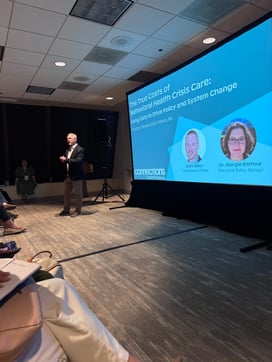 Presentation 1: The True Costs of Behavioral Health Crisis Care: Using Data to Drive Policy and System Change; Presented by Matt Miller and Dr. Margie Balfour
In this session, Dr. Balfour and Matt Miller examined the full cost of responding to behavioral health crises across healthcare, public safety and crisis systems, and explored how communities can use that data to advocate for better options. They shared how crisis services can offer a more effective and financially responsible alternative to emergency departments (ED) and jails, while highlighting the importance of policy, payment models, and cross-sector partnerships in sustaining change.
Key takeaways
- EDs and jails are costly and the wrong fit for crisis care. Psychiatric ED boarding averages $2,700 a day.
- Crisis systems work. In Arizona, a $100M investment avoided $260M in inpatient costs, and communities in Pennsylvania and Virginia saw fewer ED visits and less police involvement with a crisis system in place.
- Shared definitions and braided funding make systems sustainable. SAMHSA guidance gives providers and regulators common language, and no single funding source can cover everything.
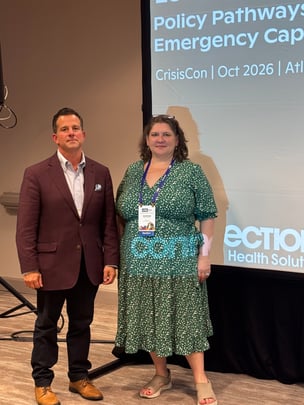 Presentation 2: Leveraging CMS Crisis Care Guidance: Policy Pathways to Expand Emergency-Capable Crisis Services; Presented by Dr. Margie Balfour and Chris Santarsiero
Dr. Balfour and Chris Santarsiero examined opportunities to expand emergency-capable behavioral health crisis services through policy and system design. They highlighted how purpose-built facilities, around-the-clock interdisciplinary care teams and a “No Wrong Door” approach can improve access for people with high-acuity needs, ease strain on hospitals and law enforcement, and offer a model that communities can adapt to local needs.
Key takeaways
- Behavioral health emergencies deserve an emergency response. Emergency-capable centers accept everyone, including people who are involuntary or highly acute, and offer a purpose-built alternative to EDs and jails.
- Federal guidance gives states a clear path. SAMHSA and CMS now recognize emergency capable services as essential, and states can fund them through Section 1115 waivers and CCBHC strategies.
- The model is replicable. Results that made Arizona a national example are being repeated in other states, with many people stabilized and discharged to community care instead of inpatient admission.
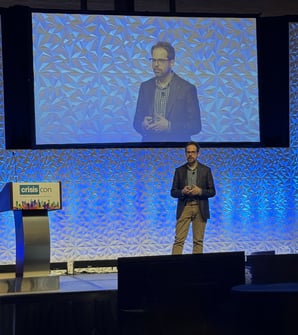 Presentation 3: Getting to Yes: Expanding Medical Capability in Freestanding Crisis Care; Presented by Dr. Kyle Jasper
Dr. Jasper challenged the assumption that patients experiencing an opioid overdose or substance withdrawal must first visit an emergency department before receiving specialized crisis care. Drawing on real-world experience, he demonstrated how clear medical protocols, on-site testing, and strong community partnerships can enable crisis centers to safely care for patients with more complex medical needs. His presentation highlighted opportunities to reduce unnecessary emergency department visits while expanding access to timely mental health and substance use treatment.
Want to learn more?
If you’d like to see the slides from our presentations or connect with our speakers, we’d love to hear from you. Reach out to us at hello@connectionshs.com.
You can also explore our resources at Resource Library